
-
Apply Now

-
Please wait...

 Start applying with LinkedIn
Master's thesis project - High Frequency Oscillation Ventilator (HFOV) - CFD Modeling
Stockholm, SE
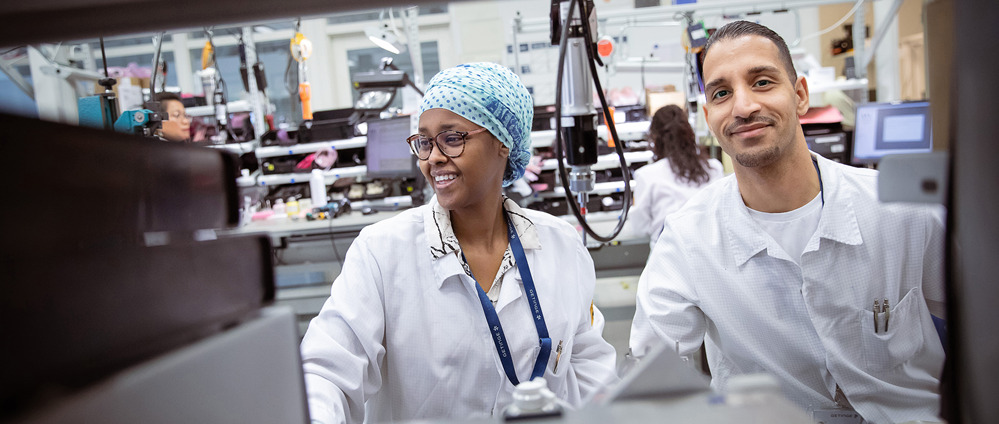
With a passion for life
Join our diverse teams of passionate people and a career that allows you to develop both personally and professionally. At Getinge we exist to make life-saving technology accessible for more people. To make a true difference for our customers – and to save more lives, we need team players, forward thinkers, and game changers.
Are you looking for an inspiring career? You just found it.
This thesis, a collaboration between Getinge and KTH, aims to develop an advanced CFD model to investigate and optimize a High Frequency Oscillation Ventilator (HFOV). The HFOV delivers very small tidal volumes at frequencies of 5–20 Hz, creating time-varying flow in the complex, compliant geometry of the lung. Current evaluation methods, mainly based on tidal volume, are too limited to capture gas exchange dynamics. The project will model CO2 elimination for varying flow/pressure profiles, patient lung characteristics, and ventilator breathing system (VBS) designs. Work includes literature review, lung geometry modeling, ventilator flow/pressure data analysis, VBS modeling, and validation against Getinge’s lab setup. Sensitivity analyses will support performance optimization. The student will gain advanced skills in CFD, biomedical engineering, and data-driven modeling, experience valuable for research careers and roles in medical technology innovation.
Background
High frequency oscillation (HFO) is a special mode of ventilation where very small tidal volumes are delivered at breathing frequencies far beyond what a breathing person can achieve (in the range of 5-20Hz).
The HFO mode is characterized by a time-varying flow with a wide frequency spectrum that is applied to a complex branching geometry (patient’s lung). The lung is compliant where the pressure affects the models’ geometrical boundaries.
Today, much of the evaluation of performance is made using the tidal volume (integrated flow pattern over an inspiration), which most likely is too blunt of an instrument to optimize the performance of the HFO.
There is a challenge related to the determination and evaluation of the performance and efficacy of this therapeutic modality and there is a need to investigate how the current state-of-the-art in CFD modeling would be able to describe and optimize this ventilation mode.
Your qualifications
- Eligible for starting Master's thesis work within science and engineering (civilingenjör).
- Program: mechanical engineering, engineering physics, biomedical engineering or similar.
- Simulation competences and/or experiences - Computational Fluid Dynamics (CFD) or Finite Element Modelling (FEM).
- Basic coding for post-processing (Python, Matlab)
Application & Contact
We kindly ask you to submit your application in our recruitment system by clicking the “apply now” button. Please note that we do not accept applications via e-mail.
If you have any questions regarding the role, please contact Principal Research Engineer Kenny Rumindo at kenny.rumindo@getinge.com.
We look forward to receiving your application. We hope you will join us on our journey to become the world’s most desired MedTech company.
About us
With a firm belief that every person and community should have access to the best possible care, Getinge provides hospitals and life science institutions with products and solutions aiming to improve clinical results and optimize workflows. The offering includes products and solutions for intensive care, cardiovascular procedures, operating rooms, sterile reprocessing and life science. Getinge employs over 12,000 people worldwide and the products are sold in more than 135 countries.
#LI-SE1
-
Apply Now
-
Please wait...